
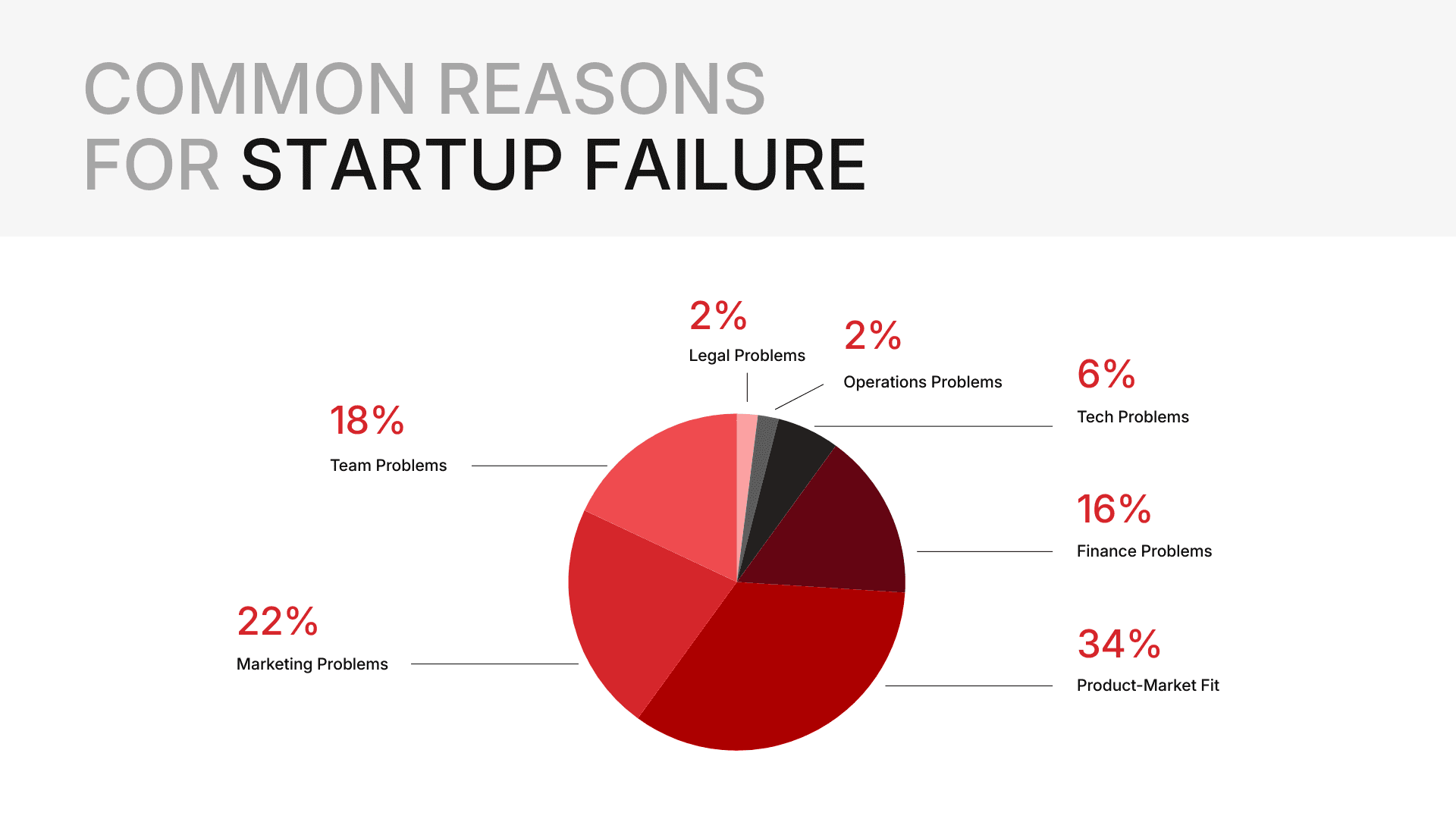
Multiple industry analyses show that roughly 80% of startups fail. According to data from the U.S. Bureau of Labor Statistics, about 20% of new businesses fail within the first year, and nearly 50% fail within five years. Venture-backed startup data from sources like CB Insights and Startup Genome show even steeper odds in high-growth ecosystems.
For mission-driven founders, this matters even more. Because when a purpose-led startup fails, the cost is not just financial. It is social. It is human. It is impact delayed.
A startup has two defining characteristics:
Innovation. You are testing assumptions that have not been tried before. This could mean a new technology, a new product, a new business model, or entering an unproven market.
Growth. You have the potential to grow exponentially, not just linearly. This usually happens because technology provides leverage, often with a marginal cost of production close to zero.
So why do so many startups collapse? And how can purpose-driven ventures avoid becoming a statistic?
1. No Market Need
CB Insights reports that 42 percent of startups fail because there is no market need. Not funding. Not competition. Not branding. No demand.
Mission-driven founders are particularly vulnerable here. When you deeply believe in your cause, you may assume others will automatically support it. But emotional conviction does not equal customer traction.
If your solution does not solve a pressing, validated problem for a clearly defined customer, impact must intersect with demand.
Before building, founders must ask:
· Who is paying?
· Why now?
· What existing behavior am I replacing?
· How urgent is this problem?
Purpose without product-market fit is advocacy. Product-market fit with purpose is scalable change.
2. Running Out of Cash
CB Insights also shows that around 38 percent of startups fail because they run out of cash. Mission-driven startups often prioritize impact over margins in early stages. That is admirable. But unsustainable economics eventually catch up.
Startup Genome’s Global Startup Ecosystem Report highlights that premature scaling is one of the most consistent failure patterns. Founders hire too quickly, expand too broadly, or overinvest in branding before validating revenue streams.
For social enterprises, this can be compounded by underpricing products in the name of accessibility, without a clear subsidy or cross-subsidy model.
The lesson is not to abandon mission. It is to build resilient financial architecture.
3. Weak Business Models
Harvard Business School research suggests that many startups fail not because the idea is bad, but because the business model is flawed.
Common issues include:
· Unclear revenue streams
· Overdependence on grants or one large client
· Unsustainable unit economics
· High customer acquisition costs with low lifetime value
Mission-driven ventures frequently rely on grants or philanthropic funding in early stages. While this can be catalytic, it can also create fragility if not paired with long-term revenue design.
Impact investing has surpassed 1 trillion dollars in assets under management globally, according to the Global Impact Investing Network. That capital is looking for scalable, measurable, and financially viable solutions.
Investors and partners increasingly expect both mission alignment and disciplined business fundamentals.
4. Poor Market Understanding
A failure to understand customer behavior, competitive dynamics, regulatory frameworks, and pricing sensitivity can derail even the most visionary founder.
The European Bank for Reconstruction and Development emphasizes that startups must analyze:
· Market size
· Growth rate
· Customer segments
· Competitors
· Distribution channels
· Pricing structures
Mission-driven founders sometimes underestimate competition. But competition validates demand. It also forces clarity.
If you cannot articulate why your solution is different and economically viable, customers and funders will struggle to justify choosing you.
5. Team and Execution Issues
CB Insights also identifies team-related problems as a major failure factor. Misalignment among founders, lack of complementary skills, and weak operational execution contribute heavily.
Startup Genome research shows that balanced teams combining technical, operational, and commercial expertise significantly outperform solo founders or homogenous teams.
For mission-driven startups, alignment is critical. Shared values are powerful. But skills diversity is essential. A team will have higher chances to succeed if they have visionaries to inspire, operators to execute, finance minds to protect runway and marketers to translate mission into demand
6. Ignoring Data and Feedback
Lean Startup methodology has shown that startups that iterate based on validated learning dramatically improve survival odds. Yet many founders fall in love with their original idea.
Mission-driven founders are especially susceptible to this. When your idea feels morally right, pivoting can feel like betrayal. But ignoring customer data is not loyalty to mission. It is rigidity.
If beneficiaries are not engaging, if customers are not returning, if pricing is blocking adoption, something must evolve.
Impact is not defined by intention. It is defined by outcomes.
What This Means for Students and First-Time Founders
· Passion is not enough.
· Good intentions are not enough.
· Social media buzz is not enough.
You need:
· Validated demand
· Sustainable revenue
· Strong team alignment
· Clear market positioning
· Continuous feedback loops
Failure rates are high. That is reality. But data is not destiny.
If you treat research as strategy, discipline as strength, and adaptability as part of your mission, your odds improve dramatically.
At GMI, we believe mission-driven companies should not just aim to survive. They should aim to build durable, measurable impact.
And that begins with understanding why others fail, so you do not repeat the pattern.
The goal is not just to start. The goal is to last.
SHARE